
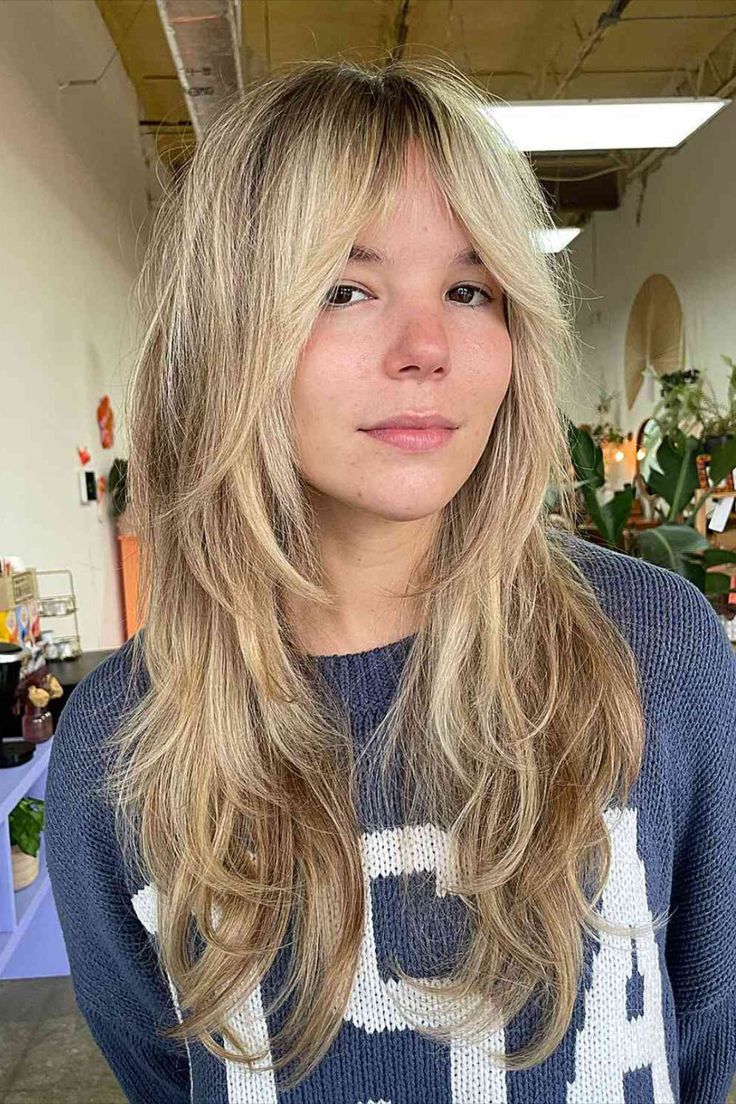
Beyond the Blanket: The Anatomy of the Perfect face-Framing Long “V” Cut
When it comes to long hair, there’s a distinct visual spectrum. At one end sits the simple, blunt cut—a thick “blanket” of hair that prioritizes max length but often sacrifices movement, leaving it feeling heavy and two-dimensional. On the other end, we have aggressive layering that can sometimes look stringy or date the style.
The definitive choice for the modern woman who demands maximum length and maximum impact is the perfect face-Framing Long “V” Cut.
This isn’t just a simple trim with some layers added on. It is a precise architectural shape—a dramatic silhouette where the hair cascades into a defined point down the back, while the entire front perimeter is softly chiseled to perfectly contour your features. This cut offers the ultimate balance: retaining that luxurious overall length down the spine while giving you a voluminous, sculpted framework for your face.
Understanding the “V” Cut Silhouette
The foundation of this specific long cut is its unique rear perimeter shape. While a traditional cut might follow a straight horizontal line or a soft “U” curve, the Long “V” Cut forms a definitive “V” shape.
To achieve this, the stylist sections the hair centrally, pulling sections forward to cut them in front of the shoulders. When the hair is then released to cascade down the back, the central sections (which travel the shortest distance forward) form the longer, defined central point, and the side sections (which travel the longest distance forward) blend seamlessly up into the shorter front layers.
The Visual Science of the “V”:
-
Perimeter vs. Interior: It’s important to distinguish between the perimeter (the absolute bottom edge) and the interior (the body of the hair). A Long “V” Cut is defined primarily by its perimeter. It is distinct from the “Invisible Layers” previously discussed, which provide interior volume. The “V” is about defining the external shape of the overall canvas.
-
The “Tapered” Effect: Because the point is the longest part, the “V” cut naturally makes your hair appear longer than a straight cut of the same measurement, as it draws the eye downward along the spine. It simultaneously reduces weight at the lower sides (the “corners” of a straight cut), preventing the hair from feeling “blocky.”
Anatomy of the Cut: Length Meets Contour
A successful Face-Framing Long “V” Cut is defined by three interconnected architectural components:
1. The Strong “V” Perimeter
The backbone of this cut is the precision of the rear point. The “V” must be symmetrical and sharp. A common mistake is leaving the point too thin or weak. A high-quality cut requires dense, healthy hair near the point. While the shape is tapered, the edges themselves must be point-cut to blend, not blunted, so they maintain movement and softness.
2. Soft, Seamless Cascading Layers
Unlike short, stacked layers, the layering within a Long “V” Cut must be soft and elongated. They should serve to “debulk” the main canvas and connect the shorter front sections smoothly to the longer rear point. Stylists often use the “slide-cutting” technique to ensure each layer flows seamlessly into the next, preventing any hard steps or blunt horizontal lines within the bulk of the hair.
3. Precision-Sculpted Face-Framing (The “Frame”)
The face-frame is the soul of this cut. It prevents the luxurious length from overwhelming your features. This isn’t just a simple bang; it is a sculpted cascade of pieces that are custom-contoured.
-
Chin to Shoulder: The cascade typically starts near the chin or cheekbone (the “high point” of the front frame) and gradually lengthens as it travels down to the shoulder and collarbone (the “connection point” to the overall length).
-
The Contour: This frame should “push” volume back away from your face. It draws the eye upward to your cheekbones and jawline, creating an instant lifting effect. The transition from the shortest front piece to the main body must be invisible.
Who is This Cut For? (And Who is it Not?)
While dynamic, the Face-Framing Long “V” Cut is a specialized tool that performs best on specific hair types.
-
Ideal Candidates: This technique is a dream for women with high-to-medium density hair that is straight, wavy, or has a loose curl pattern. It is the perfect solution for hair that feels “heavy,” “helmet-like,” or crushes natural volume. It is especially beneficial for those with round, square, or strong jawlines, as the sculpted frame creates soft, flattering angles.
-
Who Should Proceed with Caution: This is not recommended for very fine, low-density hair, as the “V” perimeter can make the ends appear sparse or see-through. Those with very tight coil patterns (Types 3C-4C) may find that the strong “V” perimeter disrupts the natural ‘stack’ of their curls.
The Art of Styling: Activating the Sculpted Shape
Because the Long “V” Cut provides extensive external structure, it makes your hair significantly more dynamic to style than a basic blunt cut.
How to Activate the Cut:
-
The Voluminous “Sculpt” Blowout: This cut is built for a bouncy blowout. Apply a root-lifting mousse. Use a large, barrel-style round brush to lift at the roots. Crucially, when drying the side sections, rotate the brush back and away from your face to emphasize the sculpted frame. Flip the hair back to let the “V” cascade down your spine.
-
Defined “Tapered” Waves: Using a large-barrel curling wand (1.25 to 1.5 inches), curl vertical sections of hair, leaving the very ends straight. When curling the face-frame, curl these pieces away from the face. The “V” perimeter will prevent the waves from “bunching” or stacking up heavy at the bottom, creating a beautiful, tapered cascade.
-
The Sophisticated Air-Dry (The Wavy/Curly Way): For natural texture, apply a defining cream or sea salt spray. The internal layers and external “V” debulking will eliminate frizz and allow natural waves or coils to find definition without being crushed by weight.
Maintenance: Honoring the Point
Unlike some low-maintenance cuts, the Long “V” Cut does require consistency to honor its defined geometry.
-
Trims: Visit your stylist every 8 to 10 weeks. If you wait much longer, the “V” point will grow out unevenly and the sculpted face-frame will lose its flattering contour.
-
The “Growing Out” Phase: This cut is not ideal if you decide to grow your hair into a blunt cut, as the sides are significantly shorter than the back. If you wish to transition to a more uniform style (like a Long “U” or Blunt cut), you must progressively trim the center point until it matches the sides.
Finding the Right Stylist
A Face-Framing Long “V” Cut is an exercise in precision and balance. It requires a stylist comfortable with geometry and razor work. It looks best when the perimeter edges are soft and blurred—which is often achieved with point-cutting or slide-cutting—not severe or blunt. Request someone with specific experience in creating contoured face-frames.
Final Thoughts: The Confident Long Silhouette
The perfect Face-Framing Long “V” Cut is for the woman who loves her long hair but refuses to let it look static, heavy, or lifeless. It is a silhouette that commands attention, offering a luxurious, tapered flow that emphasizes movement.
It is a transformation that says: “This isn’t just long hair; it’s long hair with structure, purpose, and unparalleled style.”